Currently Empty: ₹0.00

Have you ever walked into a conference room, auditorium, classroom, or meeting hall and noticed that some seats fill up immediately while others remain empty until the very end?
It happens everywhere. Whether it’s a student entering a lecture hall, an employee attending a corporate seminar, or a guest arriving at an event, people rarely choose seats randomly. Most of us make seating decisions within seconds, often without even realizing why.
The interesting part is that these choices are deeply connected to human psychology, comfort, visibility, safety, and social behavior. Understanding how people choose seats can help organizations design better spaces, improve audience engagement, and create more comfortable environments.
At Creative Seatings, we believe that seating is much more than furniture. It plays an important role in how people interact, learn, work, and experience a space. From auditoriums and educational institutions to corporate environments, the right seating design can significantly influence human behavior.
Let’s explore the fascinating science behind why people always choose certain seats first.
The Psychology Behind Seat Selection
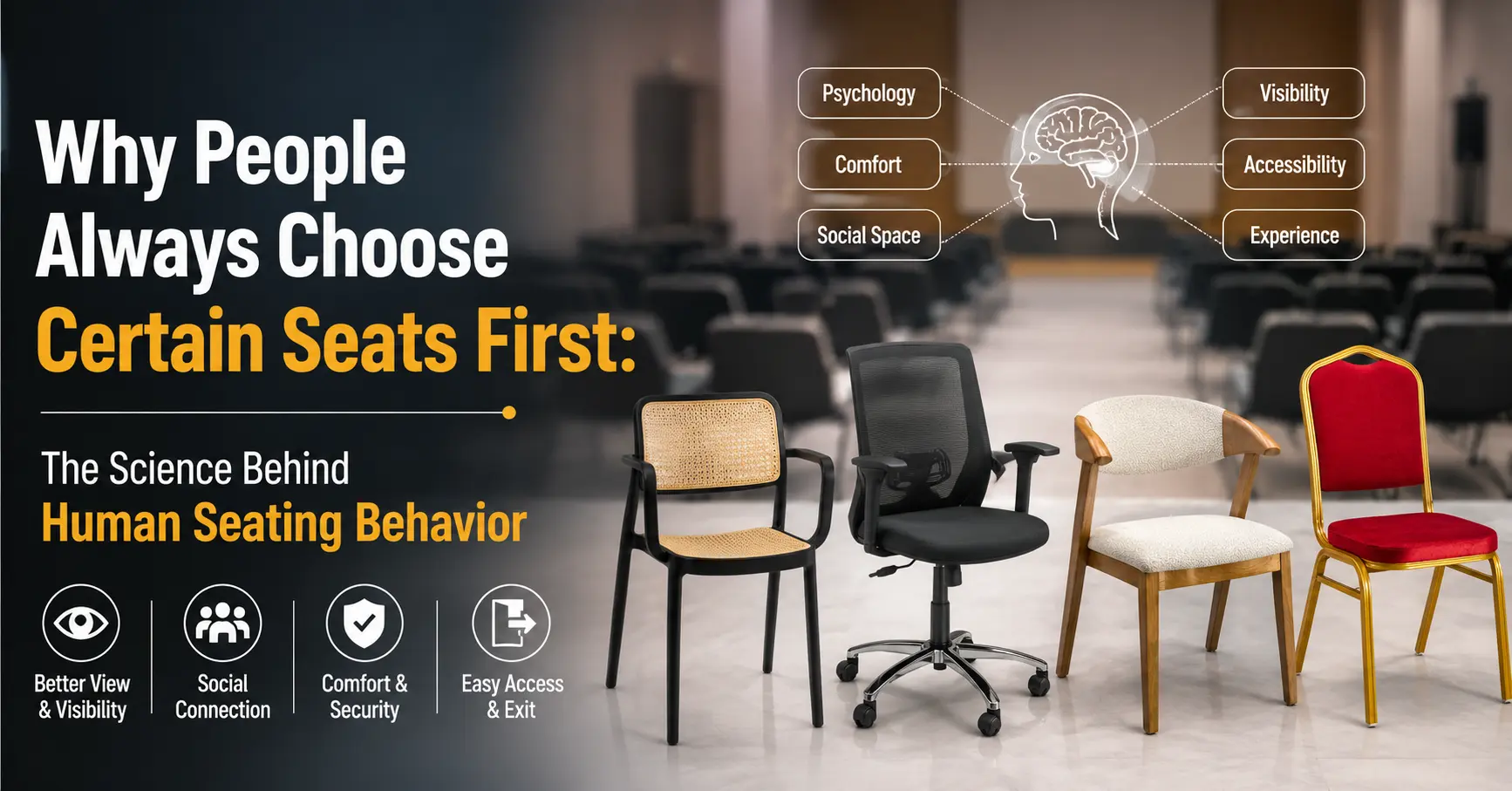
Whenever people enter a room, their brains quickly evaluate several factors before choosing where to sit.
Most people ask themselves questions such as:
- Can I see clearly from here?
- Will I be comfortable?
- Is it easy to enter and exit?
- How close am I to other people?
- Will I feel included or isolated?
These questions are often answered subconsciously within a few seconds.
Research in environmental psychology suggests that people naturally seek positions that offer both comfort and control. A seat that provides a clear view, personal space, and easy accessibility is usually more attractive than one that doesn’t.
This explains why some seats are occupied immediately while others remain empty.
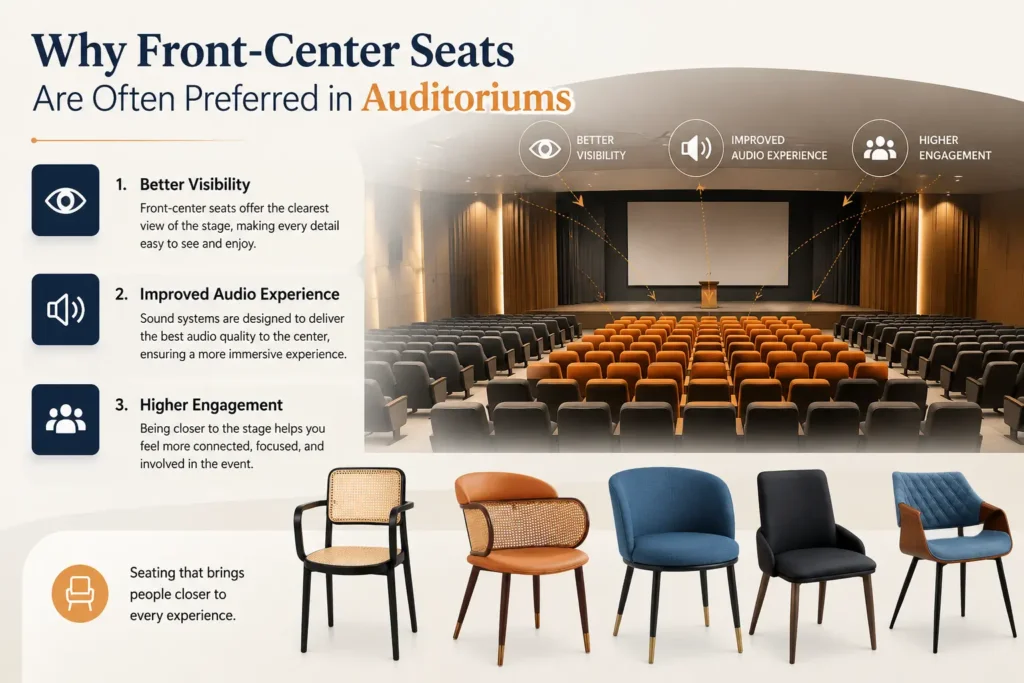
Why Front-Center Seats Are Often Preferred in Auditoriums
In auditoriums, theaters, conference halls, and seminar spaces, the center seating area often fills first.
There are several reasons behind this behavior.
1.Better Visibility
People naturally want the best possible view of the stage, speaker, or presentation screen. Center seats provide balanced sightlines and reduce neck strain.
2.Improved Audio Experience
Sound distribution is generally optimized toward the middle seating zone. Audience members often experience clearer audio when seated near the center.
3.Higher Engagement
People sitting in central locations often feel more connected to the event. They can see facial expressions, body language, and visual presentations more clearly.
This is why modern auditorium seating design focuses heavily on optimizing visibility, viewing angles, and audience comfort.
Why Students Prefer Certain Seats in Classrooms
Walk into any classroom, and you’ll notice seating patterns developing almost immediately.
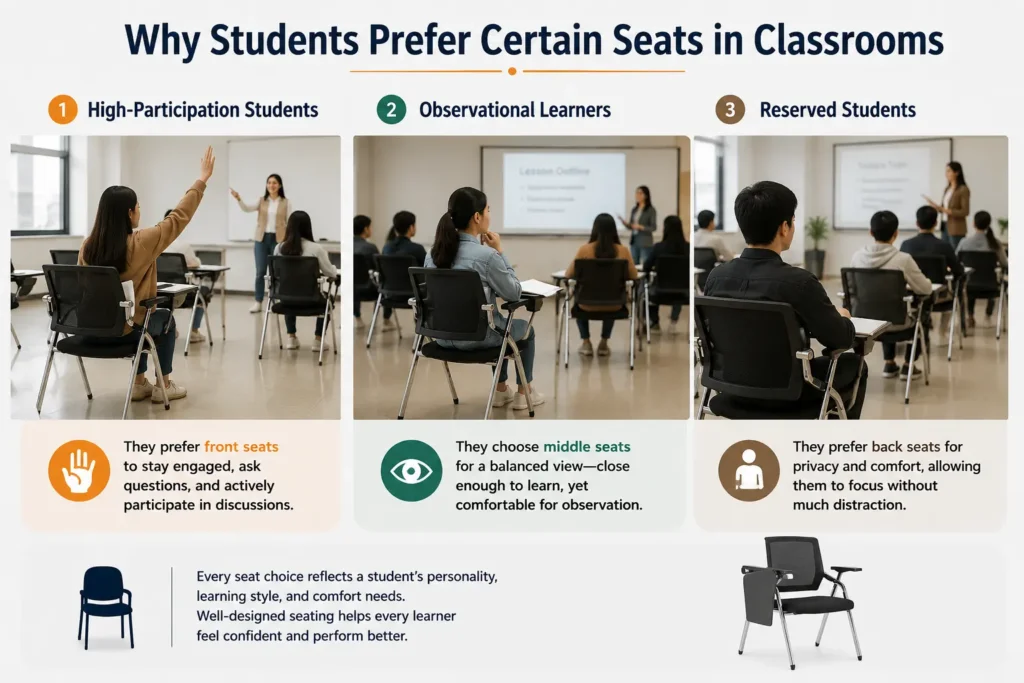
Students tend to choose seats based on personality, confidence levels, and learning preferences.
High-Participation Students
Students who actively participate often sit closer to the front. They want easier communication with instructors and better access to learning materials.
Observational Learners
Many students choose middle-row seats because they provide a balance between visibility and comfort.
Reserved Students
Some students prefer back-row seating because it provides a greater sense of privacy and reduces social pressure.
Educational institutions today recognize that classroom seating can influence concentration, participation, and collaboration. As a result, modern educational seating solutions are designed to support different learning styles while maintaining comfort for long study sessions.
Why People Avoid Certain Seats
Just as some seats are naturally attractive, others are consistently avoided.
Obstructed Views
Nobody enjoys struggling to see a presentation, speaker, or stage.
Difficult Accessibility
Seats that require multiple people to stand up before access are often selected last.
Excessive Isolation
Interestingly, people usually avoid seats that are too isolated from the group. While personal space is important, complete separation can create feelings of exclusion.
Poor Comfort
Even the best location can become undesirable if the seat itself is uncomfortable.
This highlights the importance of combining strategic layout planning with ergonomic seating design.
The Role of Personal Space
Human beings value personal space more than they often realize.
When entering a partially occupied room, people usually avoid sitting directly next to strangers if other options are available.
This behavior is influenced by what psychologists call “proxemics”- the study of how humans use space during social interactions.
Well-designed seating layouts account for this behavior by creating comfortable spacing that allows people to feel relaxed without feeling isolated.
Whether in lecture halls, conference centers, training rooms, or auditoriums, maintaining the right balance between capacity and personal comfort is essential.
How Seating Influences Audience Engagement
Many organizations focus heavily on speakers, presentations, and technology while overlooking one crucial factor: seating.
The truth is that seating directly affects audience engagement.
When people are comfortable, they tend to:
- Pay attention longer
- Participate more actively
- Retain information better
- Enjoy the overall experience
Poor seating, on the other hand, can lead to discomfort, distraction, and reduced engagement.
This is particularly important in auditoriums, educational institutions, corporate training centers, and public venues where audience attention is critical.
Why Accessibility Matters More Than Ever
Modern seating design must consider more than comfort and aesthetics.
Accessibility has become an essential aspect of creating inclusive environments.
People naturally prefer seats that are easy to access and navigate. Wide aisles, proper spacing, and thoughtful layouts improve convenience for everyone.
Organizations that prioritize accessibility create better experiences for visitors, employees, students, and guests.
Today, seating solutions are increasingly designed to combine functionality, accessibility, and visual appeal while meeting the needs of diverse users.
The Impact of Seating on Workplace Behavior
Seating behavior is not limited to classrooms and auditoriums.
Corporate environments are heavily influenced by seating arrangements as well.
For example:
- Collaborative seating encourages teamwork.
- Executive seating often reinforces leadership presence.
- Flexible seating arrangements promote creativity and communication.
- Training room seating can affect participation and learning outcomes.
As workplaces continue to evolve, organizations are paying closer attention to how seating influences productivity, collaboration, and employee satisfaction.
The right seating solution can help create environments where people feel comfortable, engaged, and motivated.
The Future of Seating Design
As architecture, technology, and user expectations continue to evolve, seating design is becoming increasingly sophisticated.
Future seating solutions will focus on:
- Enhanced ergonomics
- Better space utilization
- Sustainable materials
- Flexible configurations
- Improved accessibility
- Greater user comfort
The goal is no longer simply providing a place to sit.
Instead, seating is becoming an important tool for improving experiences, supporting human behavior, and enhancing the overall functionality of a space.
Organizations across education, corporate, public infrastructure, and entertainment sectors are recognizing the value of investing in thoughtfully designed seating systems.
What This Means for Space Designers and Facility Managers
Understanding seating behavior offers valuable insights for architects, interior designers, facility managers, educational institutions, and event organizers.
When designing a space, it’s important to ask:
- Which seats will people choose first?
- Are sightlines optimized?
- Is accessibility considered?
- Does the layout encourage engagement?
- Are users comfortable for extended periods?
Answering these questions can significantly improve the effectiveness of any environment.
Whether designing a lecture hall, auditorium, conference room, training center, or educational facility, seating should be viewed as a strategic component rather than an afterthought.
Conclusion
The next time you enter a room and instinctively choose a particular seat, remember that your decision is influenced by much more than convenience.
Human seating behavior is shaped by psychology, comfort, visibility, accessibility, social dynamics, and personal preferences. People naturally gravitate toward seats that make them feel comfortable, connected, and in control of their environment.
For organizations, educational institutions, and event venues, understanding these behaviors can lead to better space planning and improved user experiences.
At Creative Seatings, we understand that seating is not just about filling a space. It is about creating environments where people can learn, engage, collaborate, and perform at their best. Thoughtfully designed seating solutions can transform the way people experience a space, making every seat a valuable part of the overall journey.
Frequently Asked Questions (FAQs)
1. Why do people usually choose center seats in an auditorium?
Center seats generally provide the best viewing angles, balanced audio quality, and a more immersive experience, making them the preferred choice for many attendees.
2. Why do some people prefer sitting at the back of a room?
Many individuals choose back-row seating because it offers a greater sense of privacy, reduced social pressure, and a broader view of the entire room.
3. How does seating affect learning in classrooms?
Comfortable and well-planned seating can improve concentration, participation, collaboration, and overall learning outcomes for students.
4. Does seating influence workplace productivity?
Yes. Seating arrangements can impact communication, teamwork, focus, and employee engagement within workplace environments.
5. What factors should be considered when selecting seating for auditoriums or educational institutions?
Key considerations include comfort, ergonomics, visibility, accessibility, durability, space utilization, and user experience.
6. Why is ergonomic seating important?
Ergonomic seating helps reduce physical discomfort, supports proper posture, and allows people to remain focused and productive for longer periods.
7. How can organizations improve audience engagement through seating design?
By optimizing sightlines, accessibility, comfort, and seating layouts, organizations can create environments that encourage greater attention and participation.
8. What is the future of seating design?
Future seating solutions will focus on sustainability, user comfort, flexibility, smart integration, and creating more human-centered environments.